To announce a price increase, notify customers 30–60 days in advance with a personal email that states their current price, the new price, the exact effective date, and the reason for the change — then reinforce the message with an in-app notification and a help-center FAQ. Customers rarely churn over the price itself; they churn over surprises and poor communication. Tie the increase to concrete value you’ve delivered, and give long-term or high-value accounts extra notice and a personal touch.
You’re about to make a price increase to your SaaS product or software company.
And you’re worried, when you actually make the change, that all your customers are going to go bye-bye.
And if you’re anything like me, you’re thinking back to your Econ class in college.
If price increases, then what happens to the supply and demand curves?
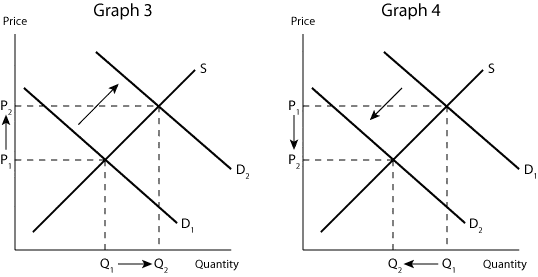
Eeesh, that’s not what your business wants!
But here’s the interesting thing:
Your Econ class operated on theory and the concept of “Ceteris paribus” meaning that if all other things were created equal (perfect substitutions, etc), then what would likely happen?
The great thing about real life is that things don’t operate in a vacuum. And things don’t happen as if all other things were created equal.
If you have a sticky product that adds value to your audience, and you increase your prices with a solid, well-thought out price increase announcement strategy, then you’ll be just fine.
Read on for tips on how to announce price increases effectively.
Table of Contents
- Price Increase Announcement Examples
- How do you announce a price increase? Step-By-Step
- How do you announce a price drop to clients?
- Common Reasons for Price Increases
- 5 Price Increase Email Templates
- Best Channels to Communicate a Price Increase
- Frequently Asked Questions

Quick Setup, Easy to Use, and Many Integrations
Manage your product announcements from a single place and easily distribute them
across multiple channels.
Price Increase Announcement Examples
Why reinvent the wheel? It’s the same thing we talked about in another article about release notes templates. Folks out there try to start from scratch when instead they can just replicate examples and templates from existing, trusted companies.
Here are a few price increase announcement examples that you can take a look at for inspiration.
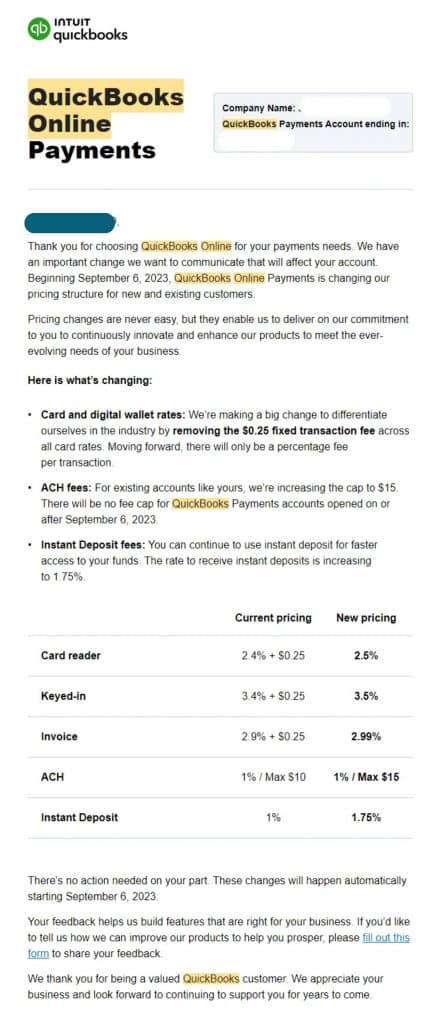
QuickBooks Online
As you see in the screenshot below, they really have thought through things and made the price change announcement clear.
No action needed on the clients’ end (which eliminates the risk of being ghosted by clients if you instead require them to give approval for the price increase)
Spotify
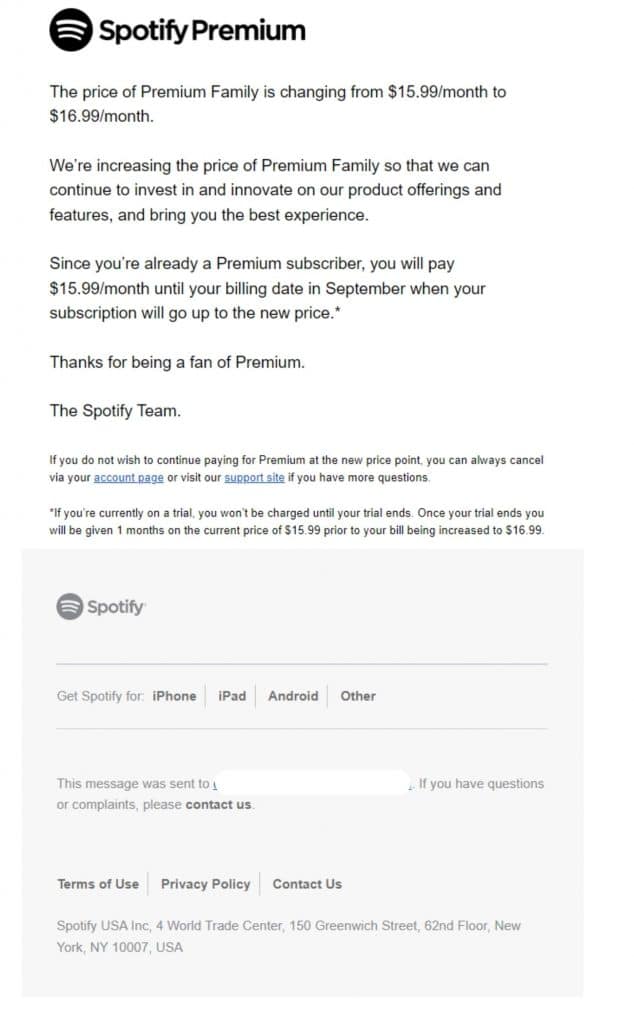
Spotify is a well-known brand. And they have quite a bit of buy-in from their users.
So in their price increase email to us, they kept it short and sweet. No reasoning for the price increase. No “OMG we’re so sorry we have to do this!”
Just the price increase and that’s it.
How do you announce a price increase? Step-By-Step:
A price increase announcement is an action taken by a company or individual to announce that the cost of their goods will be increasing. In most cases, the company does this to stay competitive with other companies and products in the marketplace or to cover rising costs.
Whatever the reason, it impacts your customers.
And Here are some tips to successfully announce price change to your audience!
- Open and Honest Communication
When it comes to adjusting prices or introducing updates, it’s vital to be transparent and forthright with your customers. By proactively informing them about impending changes, you establish a foundation of trust and minimize any potential negative impact.
- Illuminate the Reasons Behind the Shift
Unveil the driving forces behind the price adjustment to your valued clientele. Often, this shift arises from the introduction of new product features that enhance their experience. To ensure a crystal-clear understanding, articulate the added value in a compelling manner. Consider leveraging the prominent space on your website’s main page to convey this news.
- Exclusive Opportunity to Maintain Current Rates
Empower your existing patrons by offering an exclusive window to retain the current pricing structure. For example, extend a limited-time offer for maintaining existing rates when customers opt for an annual payment plan. This strategy fosters mutual benefits for both your business and your clientele, illustrating your dedication to their satisfaction.
- Attentiveness to Customer Insights
Proactively gather feedback from your customers and promptly address their inquiries whenever feasible. By doing so, you cultivate a robust bond with your client base and underscore your commitment to their needs. Prioritizing their concerns is crucial, as even in less-than-ideal scenarios, your responsiveness conveys your understanding. For deeper insights into your customers, consider using company enrichment services to enhance the data you collect during these interactions.
- Optimal Channel Selection for Announcements
Craft your announcements to reach each customer effectively through the most suitable medium. Ensuring that your message resonates with the majority of your customers is essential, and guaranteeing comprehensive awareness of the price changes is paramount.
This is frequently done via email. But it can also be done through in-app notifications, banners, and more.
While AnnounceKit has specific features like a release notes tool, it also has much more than that… All things announcements (widgets, emails, banners, and more).
- Tailoring the Perfect Communication Tone
Discern the unique characteristics of your diverse customer personas to strike the perfect communication chord. Adjust your wording to cater to various segments effectively. Harness the power of user segmentation to identify the language that resonates best with each group, fostering a stronger connection.
There are other ways that you can make announcements interesting.
Price Increase Announcement Template
Hi there,
As X [date] approaches, we’ve reached a point where a pricing update is necessary to maintain our long-term investment in making [company name] the most powerful, user-friendly, and intuitive [descriptive keyword for your solution] in the world. We’re adjusting our pricing starting **[price increase date] **, to more accurately reflect the value you get and to make room for some great new social proof tools and features coming your way. Here are the new tiers: Here are the new tiers:
- [Plan 1]: New Price – Old price
- [Plan 2]:
- [Plan 3]:
- [Plan 4]:
This change will help us develop better features that are easy to use while still keeping our prices competitive. In fact, we’ve been able to add more than [number of new features] new features & integrations under the hood, over the past two years without raising our prices. We are already well-known for our excellent customer support and that will never change, for both free and paying customers. Our Premium Support is available for everyone via the live chat on our website.
Upcoming Features:
[ New Feature 1 ]: Explain your feature here
[ New Feature 2 ]:
[ New Feature 3 ]:
[ New Feature 4 ]:
Have any questions or concerns? Just reply to this email or reach out via the live chat on our website.
Thanks always,
How do you announce a price drop to clients?
Many business owners are asking themselves, “How do you announce a price drop to clients?” You need to think about how your company’s customers will react. The price drop announcement should let the customer understand what is happening. Here are our tips for managing your price drop announcement!
1- Explain What Made Price Drop Possible
It is the most critical part of the price drop announcement since some of your customers might be suspicious about the price drop. Put differently, and they might not feel good about the change unless you explain them clearly.
2- Ensure Your Customers That Quality Will be the Same
Your customers’ concern about quality is highly understandable. Before they feel concerned about the quality, you need to make sure that your service quality will be the same. That might be effective to show some concrete examples or proofs for it
3- Show your Goodwill
Demonstrate that you understand your customer`s concerns. In a nutshell, thank your customers for being your customers and use your empathy skills. In the long term, it will help you to build stronger relationships.

4- Do not Use a Marketing Jargon
Marketing jargon for a price drop can be irritating in most cases. However, it also depends on your business type and the reason for a price drop. It is safe to be natural and avoid marketing jargon for a price drop to your existing customers.
Price Decrease Announcement Template
Dear [Customer]:
We are so grateful for the pleasure of serving you and hope we met your expectations.
At [Your Company], we aim to improve our customer value and satisfaction. We are working hard to find new ways to increase the satisfaction of our community. We regularly review our expenses and price lists to provide our value at the most affordable price possible.
We are happy to announce the good news! We have decided to reduce our price from [Old price] to [New Price].
Our price change will be valid, starting from [Date].
As we put our customers’ happiness as our priority, we certainly believe that providing maximum value at a fair price will increase customer satisfaction.
Have any questions or concerns? Just reply to this email or reach out via the live chat on our website.
Thank you
Common Reasons for Price Increases
Before you draft your price increase announcement, it helps to understand — and be able to articulate — why prices are going up. Customers are far more understanding when they receive a clear, honest explanation rather than a vague notice. Here are the most common legitimate reasons companies raise prices, and how to frame each one.
Rising Operational Costs
Inflation, supplier price hikes, increased labor costs, and rising infrastructure expenses all eat into margins over time. If your costs have gone up significantly since your last pricing review, a price increase is a business necessity — not a choice. When communicating this to customers, be transparent without going into granular financial detail. Something like “our supplier and operational costs have increased substantially” is honest and relatable without oversharing.
Significant Product or Feature Improvements
If you’ve added major new features, improved reliability, or substantially expanded what your product does since the last pricing update, a price increase reflects the increased value you’re now delivering. This is the easiest price increase to justify because it’s customer-centric: customers are getting more, so paying more is fair. Highlight the specific improvements that customers have asked for and now benefit from.
Market and Competitive Alignment
Sometimes prices simply fall out of step with the market. If competitors are charging meaningfully more for comparable or lesser products, staying artificially low can actually undermine customer perception of your quality. Realigning with market rates is a valid and common reason for a price increase — and customers generally understand it when framed as “ensuring we can continue to invest in and maintain the quality you expect.”
Supply Chain Disruptions
Global supply chain volatility — from shipping delays to component shortages — has become a standard business reality. If your product relies on physical goods, raw materials, or third-party components that have become more expensive or harder to source, this is a straightforward and sympathetic reason to raise prices. Most customers understand supply chain pressures from their own lives and businesses.
5 Price Increase Email Templates for Different Scenarios
The right template depends on why you’re raising prices and who your customers are. Below are five ready-to-use email templates covering the most common price increase scenarios. Each is designed to be honest, customer-focused, and clear about what’s changing and when.
Template 1: Standard Price Increase Notice (Any Business)
Best for: Any business that needs a clear, professional default template with no special circumstances.
Subject: Upcoming change to your [Product Name] pricing
Dear [Customer Name],
We’re writing to let you know that the price of your [Plan Name] plan will change from [Old Price] to [New Price] per [month/year], effective [Date] — [X] days from today.
Nothing changes before then, and you don’t need to take any action. Your features, data, and billing method all stay the same — only the price is updated.
This adjustment allows us to keep investing in [Product Name] and the support you rely on. If you have any questions about how this affects your account, just reply to this email and we’ll be happy to help.
Thank you for being a customer.
[Your Name]
[Your Company]
Template 2: Value-Driven Price Increase (New Features)
Best for: SaaS companies that have added significant new features or capabilities.
Subject: We’ve added a lot — here’s what’s changing with pricing
Dear [Customer Name],
Over the past [X months/year], we’ve added [list 2-3 key features] to [Product Name] — features that [specific benefit]. We’ve also improved [reliability/speed/support], based directly on your feedback.
To continue building at this pace and delivering the quality you rely on, we’re updating our pricing. Starting [Date], your plan will move from [Old Price] to [New Price] per [month/year].
You won’t see any changes until [Date], and we’ll send a reminder before your billing updates. If you have questions about what’s new or what this means for your account, just reply to this email — we’re happy to walk you through it.
Thank you for growing with us.
[Your Name]
[Your Company]
Template 3: Cost-Driven Price Increase (Operational Costs)
Best for: Businesses where rising supplier, labor, or infrastructure costs are the primary driver.
Subject: An important update to [Product/Service] pricing
Dear [Customer Name],
We want to be upfront with you: our costs have increased significantly over the past year, including [supplier costs / infrastructure / labor]. Like many businesses, we’ve been absorbing these increases as long as we can — but to continue delivering the quality and reliability you expect, we need to make an adjustment.
Effective [Date], our pricing will change from [Old Price] to [New Price].
We’ve worked hard to keep this increase as small as possible while ensuring we can continue to invest in the service quality you rely on. Your current pricing will remain unchanged until [Date], giving you time to plan accordingly.
Thank you for your understanding and your continued trust in us.
Sincerely,
[Your Name]
[Your Company]
Template 4: Market Realignment Price Increase
Best for: Companies whose pricing has fallen significantly below market rates for equivalent products.
Subject: Updating our pricing to reflect the value we deliver
Dear [Customer Name],
We’ve kept our pricing unchanged for [X years] because we wanted to focus entirely on building the best possible product for you. As [Product Name] has grown and matured, we’ve invested heavily in [feature areas, support, infrastructure].
As part of our commitment to sustaining that investment, we’re updating our pricing to better reflect the value we deliver. Starting [Date], your plan will change from [Old Price] to [New Price].
We believe this still represents exceptional value for what you get — and we remain committed to earning your business every day. If you’d like to discuss your plan options or have any questions, please don’t hesitate to reach out.
Best,
[Your Name]
[Your Company]
Template 5: Subscription Renewal Price Increase
Best for: Annual subscription businesses notifying customers ahead of their renewal date.
Subject: Your upcoming renewal — updated pricing for [Year]
Dear [Customer Name],
Your [Product Name] subscription is up for renewal on [Renewal Date]. We want to give you plenty of notice that our pricing has been updated for [Year].
When your subscription renews on [Date], your rate will change from [Old Price] to [New Price] per year. This reflects [brief reason: continued platform investment / expanded feature set / rising infrastructure costs].
Your current pricing remains locked in until your renewal date. If you renew early, we can honor your current rate through [Date]. To take advantage of that, just reply to this email or contact our team at [support email].
Thank you for being a [Product Name] customer. We look forward to another great year together.
[Your Name]
[Your Company]
Best Channels to Communicate a Price Increase
Knowing what to say is only half the challenge — knowing how to deliver the message matters just as much. The right channel ensures your announcement is seen, understood, and doesn’t feel like it came out of nowhere. Here’s how to think about each major communication channel.
Email (Primary Channel)
Email is the gold standard for price increase announcements because it’s direct, documented, and personal. Every affected customer should receive an individual email — not a mass blast that feels impersonal. Personalize it with their name, their current plan, their specific old and new price, and their exact transition date. Send the first notice at least 30-60 days in advance, with a reminder 1-2 weeks before the change takes effect. This gives customers time to plan and reduces support tickets. If you need inspiration for structure and tone, these real product update email examples show how established companies write customer-facing change emails.
In-App Notifications
In-app announcements are a powerful complement to email, especially for SaaS products where customers are logging in regularly. An in-app notification ensures that even customers who miss your email still see the announcement in context. Tools like AnnounceKit make it easy to create targeted in-app announcements that appear only to affected user segments — so you can notify paid customers without showing the message to trial users or other plans. In-app notifications also let you link directly to more details or an FAQ, reducing support load. Pick the format deliberately — this comparison of in-app banners vs. modals vs. tooltips explains which widget fits a high-stakes message like a price change (hint: not a tooltip).
Help Center / Knowledge Base Article
Publish a detailed FAQ or knowledge base article explaining the price change — what’s changing, why, when it takes effect, and what options customers have. Link to it from both your email and your in-app notification. This gives customers a place to get answers without waiting for support, and it reduces the volume of inbound questions your team needs to handle. Update the article as questions come in during the transition period.
Direct Outreach for High-Value Accounts
For your largest or most strategic accounts, email alone isn’t enough. A personal call or video meeting from their account manager — before the formal announcement goes out — shows respect and gives them a chance to ask questions privately. High-value customers who feel blindsided by a price increase are churn risks; high-value customers who feel informed and respected are retention wins. Always give your biggest accounts a heads-up before the general announcement.
Frequently Asked Questions About Price Increase Announcements
How far in advance should you announce a price increase?
For most SaaS and subscription businesses, 30-60 days notice is the minimum. If you have annual contract customers, consider giving 60-90 days notice so they can plan their budgets accordingly. The more notice you give, the better — it signals respect for your customers and reduces churn from customers who feel blindsided. For enterprise accounts, a personal conversation before the formal announcement is ideal.
How do you politely announce a price increase?
Be direct, honest, and customer-focused. State the new price clearly, give the exact date it takes effect, and explain the reason in plain language. Avoid corporate jargon and focus on the value the customer is receiving. Acknowledge that it’s a change and thank them for their continued business. Don’t bury the price change at the bottom of a long email — put it near the top so customers aren’t surprised when they reach the number.
Should you apologize for a price increase?
Avoid over-apologizing — it can undermine your confidence in the decision and make customers more anxious than necessary. A brief acknowledgment like “we understand this is a change” is appropriate, but excessive apologetic language signals that the increase isn’t justified. If you believe the price increase is fair and necessary, communicate it with calm confidence. Customers are more accepting of price increases when the company communicates clearly and without excessive hand-wringing.
What should you do if customers push back on a price increase?
First, listen. Understand whether their concern is about the price itself, the timing, or the perceived value they’re receiving. If a customer genuinely isn’t getting enough value at the new price, it may be worth exploring whether a different plan or feature set is a better fit. For customers who are long-term and high-value, some companies offer a loyalty rate or a grandfather period. However, avoid making blanket exceptions that undermine the pricing change — it signals that the announced price isn’t real.
How do you announce a price increase to long-term customers?
Long-term customers deserve extra care. Acknowledge the length of your relationship directly in your communication, and consider giving them a longer transition period or an opportunity to lock in their current rate for one additional billing cycle. Emphasize the value they’ve received over the relationship and the investment you’re making to continue delivering it. A personal note from a founder or senior team member can go a long way with customers who have been with you for years.
Can a price increase actually improve customer retention?
Counterintuitively, yes — when done right. A well-communicated price increase that clearly ties the new price to improved value can actually increase customer commitment. Customers who stay through a price increase are often your most engaged and loyal segment. Poorly communicated price increases, on the other hand, accelerate churn among already-disengaged customers — which can be a useful if uncomfortable signal about your customer health. Use the price increase process as an opportunity to reconnect with your customer base and restate your value proposition clearly.
Feedback Collection
Collecting feedback from your customers is an important and sometimes challenging task. Analyzing customer feedback helps you to understand your customer better and fastens your growth!
Also, we recommend you to read “How to Ask for Feedback? 7 Smart Ways to Collect Customer Feedback to Improve Customer Experience