SaaS pricing strategy is one of the most confusing issues for marketing teams and company founders. I can only guess what the actual value of your service is for you. However, there are also the actual dynamics of the industry you serve.
Based on my experience with start-up companies and SaaS products, I am convinced that you can lose customers before you even get them on board by implementing a high SaaS price strategy. But if you get paid too little, you won’t be able to support your service or pay your employees.
There’s a fine line between making a profit and going bankrupt, right? I’m sure the following question is echoing in your mind right now: So what should be the SaaS pricing strategy to manage a successful SaaS company?
Don’t worry, you are here to get the answer to this question. If you’re ready, I can start finding answers to your questions. 😏
What is a SaaS Pricing Strategy?
The SaaS price strategy is that the software product you offer as a service has plans and prices that will bring you income and make a profit in the long run, taking into account the market conditions.
You can grow your customer base quickly and become one of the leading SaaS products in your field by executing marketing activities in harmony with the right price strategy.
Why is a pricing strategy so important?
The answer is quite simple: if you make money you will survive, if you don’t you will go bankrupt.
It is possible to say that the post-corona period has been difficult for technology companies. They thought that the momentum in sales would be constantly up. However, the balloon burst.
According to CrunchBase News, the number of people laid off from technology companies in the United States has exceeded 39,000. This has two implications: companies will be more careful when spending money, and the money in the SaaS industry will decrease somewhat.
If you do not want to downsize or lay off your employees, you need to determine the most accurate plan and prices for you. That is the answer to why the SaaS price strategy is important!
The right questions bring valuable answers
Before determining your SaaS pricing strategy, you have to ask yourself some questions to get to know your product and market size. These questions are:
- Is our product unique and unrivaled?
- What is the pricing strategy of our competitors?
- What is the market size?
- What is the added value of our product?
1) Is our product unique and unrivaled?
If you are the first product in your market, determining your pricing strategy is relatively easy. The service you provide is one of a kind, as it is a world-class service.
Think of it this way, Netflix was the only TV/movie provider for many years. I don’t think people have very strong opinions about Netflix’s pricing policy. You can compare something when it’s equivalent. It is difficult to compare when your product is unique.
But there are many publishers these days, and people can compare prices and say it’s a cheap or expensive service.
In summary, when you have a unique product, you are freer to set the SaaS pricing strategy and it is easier to get users to accept your strategy.
2) Examine your competitors’ pricing strategies
When it comes to pricing your SaaS product, it’s important to take a look at what your competitors are doing. Examine their pricing strategies and see what you can learn from them.
One thing to look at is the pricing model they’re using. Are they charging per month? Per user? What features are included in their pricing plans?
Another thing to look at is how they position their prices relative to other products on the market. Are they the cheapest option? The most expensive option? somewhere in the middle?
Finally, consider the discounts and promotions they offer. Do they have any special deals for new customers? For volume customers? For annual contracts?
By taking a close look at your competitor’s pricing strategies, you can develop a better understanding of what works in the market and what doesn’t. This will help you to create a more effective SaaS pricing strategy for your own SaaS product.
3) What is the market size?

You cannot decide independently of the market you are in when determining the price for your product. Market size is the total number of potential customers you can sell to. When you know the market size, you can better determine how much to charge for your product or service.
To measure market size, you need to know certain metrics. Thanks to these metrics, you can make more rational calculations. Reading by this useful content, you will find the information you need!
You should not only consider your prices based on market size, but also your target audience. What are they ready to pay? What are their needs and wants? You need to keep all these in mind when determining a SaaS pricing strategy.
4) What is the added value of our product?
Another point to consider when determining the price of your product is the benefit of your product.
Have you noticed that not all SaaS products have a free trial? There is a simple reason for this. Products focused on specific areas that you can use right away do not have a free trial option. These products are charged directly. Typically, marketing-related products fall into this category.
Products that give you more benefits in planning and productivity have a free trial option. Because people do not want to easily allocate a budget for these products. For example, products like Notion or Milanotes fall into this category.
Whichever of these two product groups defines your product, you need to determine your SaaS pricing policy. So you decide whether to have the free trial option or not.
AnnounceKit on the stage! 🐱🏍
AnnounceKit is an all-in-one changelog tool that helps you to create targeted new feature announcements, share them within an in-app notification center, send announcement emails and distribute them across social media channels.
AnnounceKit has plans suitable for all companies large and small. I can’t think of a better SaaS product to effectively deliver your announcements to your audience. This is my purely objective interpretation. 😛
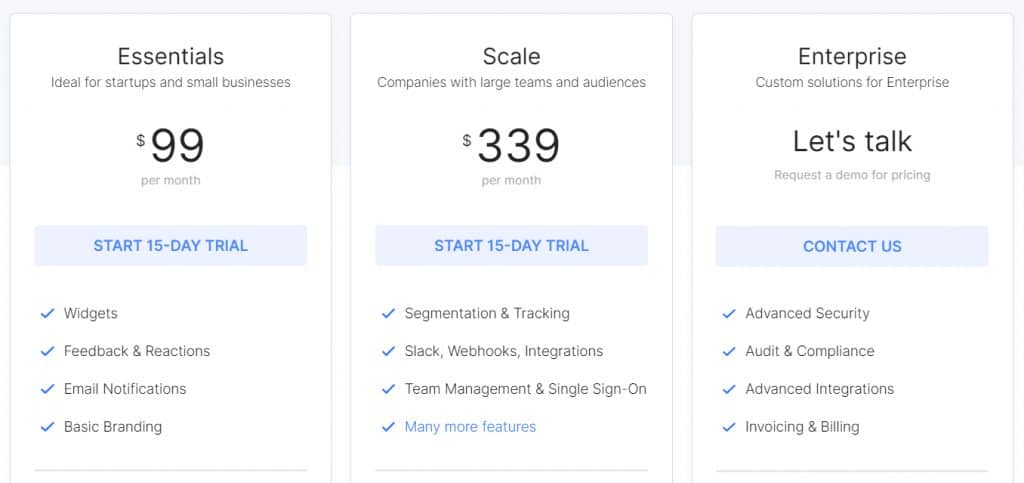
The best way to understand the benefits of a product is to use it. AnnounceKit is waiting for you with all its features! Also, if you’re thinking of making changes to your existing product prices, don’t forget to check out our great content to guide you.
SaaS Pricing Models Explained: The 7 Core Approaches
A SaaS pricing model is the structural framework that determines how you charge customers for access to your software. Choosing the right model is the single most impactful pricing decision you will make — it shapes acquisition, expansion revenue, and churn far more than the specific number you set. Below are the seven models used by the most successful SaaS companies today.
1. Flat-Rate Pricing
Flat-rate pricing is a single price for all users with access to all features — one product, one price, one subscription. It is the simplest model to communicate and sell. Pros: easy to understand, predictable revenue, low friction in the buying decision. Cons: leaves expansion revenue on the table, no way to capture value from power users. Best for: early-stage SaaS companies with a narrow feature set or a homogeneous customer base. Example: Basecamp charges a flat $99/month for unlimited users and projects — a deliberate positioning choice that eliminates negotiation and reduces churn caused by seat-count anxiety.
2. Per-User (Seat-Based) Pricing
Per-user pricing charges a set amount for each active user on the account. It scales naturally with the size of your customer’s team, making it the most common model for B2B SaaS. Pros: revenue grows automatically as customers hire; straightforward for both vendor and buyer. Cons: creates an incentive to share login credentials and can cause sticker shock at larger team sizes. Best for: collaboration tools, CRMs, and project management platforms where value scales with team adoption. Example: Salesforce built its business on per-seat pricing — the more reps a company hires, the more Salesforce earns without any additional sales effort.
3. Usage-Based Pricing
Usage-based pricing (also called consumption pricing or pay-as-you-go) charges customers based on how much they actually use the product — API calls made, emails sent, data processed, or transactions completed. Pros: low barrier to start, aligns cost with value delivered, naturally expands with customer growth. Cons: unpredictable revenue, harder to forecast, may feel opaque to buyers. Best for: infrastructure, communication APIs, and AI tools where usage varies dramatically by customer. Example: Twilio and AWS built billion-dollar businesses on pure usage pricing — customers pay nothing until they use the product, then grow into significant accounts organically.
4. Tiered Pricing
Tiered pricing bundles features into 2 to 4 distinct plans (typically Starter, Pro, and Enterprise) at increasing price points. Each tier includes more features, higher limits, or better support than the one below it. Pros: serves multiple customer segments simultaneously, creates a clear upgrade path, drives natural expansion MRR. Cons: requires careful feature allocation — put the wrong feature in the wrong tier and you either block adoption or give away margin. Best for: companies serving both SMBs and enterprises, or products with a wide feature set. Example: HubSpot’s Free to Starter to Professional to Enterprise tiering is a masterclass in tiered SaaS pricing — each tier unlocks automation and reporting capabilities that make the next tier feel necessary as a business scales.
5. Freemium Pricing
Freemium is a two-tier model where the core product is free forever, with paid plans unlocking advanced features, higher limits, or team collaboration. It is not a pricing model so much as a distribution strategy — you are using a free product to build a user base and convert a percentage to paid. Pros: massive top-of-funnel, low CAC through word-of-mouth, allows users to experience value before paying. Cons: high infrastructure cost for free users, conversion rates typically 2 to 5%, and free users generate support tickets. Best for: products with strong viral loops and low marginal cost per user. Example: Notion’s freemium model drove millions of individual signups — many of whom then introduced the tool to their employers, driving enterprise sales with near-zero outbound.
6. Feature-Based Pricing
Feature-based pricing gates specific features behind paid tiers rather than (or in addition to) usage limits. Customers can use the core product freely but pay to unlock advanced capabilities like analytics, integrations, or automation. Pros: lets users experience the product before hitting a paywall, creates natural upgrade moments at the point of need. Cons: requires deliberate feature flagging and can frustrate users who hit paywalls mid-workflow. Best for: products where a subset of high-value features (like advanced reporting or API access) are disproportionately valuable to power users. Example: Loom offers free video recording with limits on video length and storage — advanced features like custom branding and analytics are gated behind paid plans.
7. Hybrid Pricing
Hybrid pricing combines two or more models — most commonly a per-seat base fee plus usage-based overages, or a flat monthly fee with consumption-based add-ons. This approach captures the predictability of subscription pricing while retaining upside from high-volume customers. Pros: maximizes revenue capture across customer segments, reduces churn from low-usage customers who would balk at pure usage billing. Cons: more complex to communicate and bill; requires a billing infrastructure that handles both models. Best for: mature SaaS companies with heterogeneous customer usage patterns. Example: Many modern AI tools charge a flat monthly subscription for access plus per-token fees for heavy usage — ensuring casual users find the price fair while power users pay proportionally.
SaaS Pricing Psychology: Tactics That Convert
The psychology of pricing is as important as the model itself. How you present a price influences perceived value more than the number alone. These four psychological tactics are used by every major SaaS company and are backed by decades of behavioral economics research.
Price Anchoring works by presenting a high-priced option first, making subsequent options feel reasonable by comparison. When a visitor sees an Enterprise plan at $499/month before they see the $49/month Pro plan, the Pro plan feels like a bargain — even if they would have considered $49 expensive without the anchor. Most SaaS pricing pages lead with their highest tier for exactly this reason. The anchor does not need to be a plan the buyer will choose — it just needs to recalibrate their reference point.
Charm Pricing is the practice of pricing at $X.99 or $X9 rather than round numbers. The cognitive effect is well-documented: $49/month reads as “in the $40s” before the brain processes the full number. While B2C SaaS uses this heavily, many B2B SaaS companies avoid it as it can signal a consumer-grade positioning. The right choice depends on your buyer persona — product-led tools targeting individual users typically benefit from charm pricing, while enterprise tools targeting procurement teams are better served by round numbers that signal confidence.
Decoy Pricing (also called the asymmetric dominance effect) involves introducing a third option specifically designed to make one of the other options look clearly superior. In a classic three-tier SaaS pricing page, the middle tier is often priced to make the top tier look like outstanding value — the gap between the middle and top tier is small relative to the massive feature difference. Research by behavioral economist Dan Ariely showed that a strategically placed middle option can increase selection of the top tier by over 30%. If your highest-margin plan is your top tier, a well-constructed middle option pays for itself immediately.
The Centre-Stage Effect refers to the psychological tendency to choose the option presented in the visual center of a layout. Most SaaS pricing pages highlight the middle plan with a “Most Popular” badge and a contrasting color — not because the middle plan is actually most popular, but to direct attention there. The effect is powerful: highlighted plans consistently outsell unhighlighted ones, even at higher price points. Pair this with a well-placed annual billing toggle and you can significantly increase both conversion rate and LTV simultaneously.
Real-World SaaS Pricing Examples: What Top Companies Do
The best way to develop pricing intuition is to study companies that have already solved the problem at scale. Here are four SaaS pricing strategies that generated measurable business results.
Slack: Fair Billing to Eliminate Upgrade Friction. Slack uses per-active-user pricing with a “Fair Billing” policy: customers are only charged for users who actually logged in during the billing period. This sounds like a revenue sacrifice but is actually a brilliant retention mechanism — it removes the fear of paying for shelfware. Enterprise buyers who worry about unused seats across a 500-person org can now adopt Slack broadly without a pricing penalty for low-engagement users. The result: Slack became one of the fastest SaaS companies to reach $1 billion in ARR, in part because their pricing removed the single biggest objection from large enterprise buyers.
Notion: Freemium as a Distribution Engine. Notion’s free tier is genuinely useful — individuals can build entire personal wikis, databases, and project trackers at no cost. This is a deliberate funnel. Individual users adopt Notion personally, build habits around it, and then introduce it at work. Notion’s enterprise sales pipeline is substantially powered by bottom-up adoption that started on the free tier. Their conversion from free to paid accelerated when they introduced team collaboration features as a hard paywall — a moment that naturally occurs when a user tries to share their workspace with a colleague.
HubSpot: The Land-and-Expand Tiering Masterclass. HubSpot’s pricing is an architecture designed for expansion revenue. Their free CRM is the entry point — genuinely functional for small teams with no trial expiration. As a company grows, they hit friction points: they need email automation (Starter), then advanced segmentation and reporting (Professional), then custom objects and API access (Enterprise). Each upgrade is triggered not by an artificial paywall but by natural business growth. HubSpot’s net revenue retention consistently exceeds 100%, meaning they earn more from existing customers each year than they lose to churn — the definition of a successful expansion pricing strategy.
Canva: Surgical Freemium That Converts Professionals. Canva identified that the most painful moment for free users was hitting brand kit and team folder limits when trying to collaborate with a client or colleague. Rather than broadly restricting features, they placed the paywall precisely at the point of maximum perceived pain — the moment a user realizes they need the tool for professional work. This surgical freemium design keeps the free tier genuinely valuable for individuals while making the paid tier feel essential for anyone using Canva professionally, resulting in a paid conversion rate significantly above typical freemium benchmarks.
Value-Based Pricing for SaaS: Why It Outperforms All Other Models
Value-based pricing is the practice of setting your price based on the economic value your product delivers to customers — not your costs, not your competitors’ prices, and not what feels comfortable to charge. It is universally regarded as the highest-margin pricing approach available to SaaS companies, and it is also the hardest to implement correctly.
The foundational principle of value-based SaaS pricing is the 10x rule: your product should deliver at least 10 times the value it costs. If your tool saves a marketing team 20 hours per month and that time is worth $50/hour, you are delivering $1,000/month in value — meaning you can charge up to $100/month and still leave the customer feeling they got an excellent deal. Most SaaS companies undercharge precisely because they anchor their pricing to costs or competitor pricing rather than to customer value. The 10x rule recalibrates the conversation: start from the value delivered and work backward to a price.
Implementing value-based pricing requires genuine willingness-to-pay (WTP) research. The most effective method is the Van Westendorp Price Sensitivity Meter: ask prospects four questions — at what price would this product be so cheap you would question its quality? At what price is it a bargain? At what price does it start to feel expensive? At what price is it too expensive to consider? The intersection of these curves reveals your optimal price range. Combine this with jobs-to-be-done interviews — ask customers what they were using before your product and what it cost them in time and money. That alternative cost is your pricing ceiling. Pricing at 10 to 30% of the value you replace is typically both competitive and highly profitable.
When you shift to value-based pricing, you will often need to raise prices for existing customers. This is where a well-crafted price change announcement becomes critical. Tools like AnnounceKit allow SaaS teams to communicate pricing changes through in-app notifications and a changelog — ensuring users hear about changes directly in the product, with full context, before they see an unexpected charge. Transparent, well-timed pricing change communication is the difference between a price increase that drives churn and one that increases customer trust.
SaaS Pricing Trends in 2026: AI, Usage-Based, and Hybrid Models
The SaaS pricing landscape has shifted materially since 2022. Three trends are reshaping how companies charge for software, and understanding them is essential for any SaaS founder or product leader setting pricing strategy today.
The Rise of Usage-Based Pricing in AI SaaS. AI-powered SaaS products have made usage-based pricing the dominant model for a new category of tools. When a product’s primary value is generated by an AI model that has real marginal costs per inference, flat-rate pricing quickly becomes unprofitable at scale. This has driven a wave of hybrid pricing — a base subscription for access and team features, plus consumption-based pricing for AI-generated outputs (tokens, generations, analyses). Usage-based components now appear in the majority of new SaaS products launched since 2023. If you are building an AI-powered SaaS product in 2026, pure flat-rate pricing is likely leaving significant revenue on the table.
Annual Pricing Incentives Are Becoming More Aggressive. As SaaS companies face greater pressure to demonstrate net revenue retention and reduce churn, annual commitment incentives have grown significantly. The industry standard was historically 10 to 20% off for annual billing; many SaaS companies now offer 30 to 40% discounts for annual plans, or include meaningful feature unlocks (additional seats, higher limits, priority support) that make monthly billing feel genuinely inferior. The financial logic is sound: a customer locked into an annual plan has a significantly higher renewal rate than a monthly subscriber. If your annual-to-monthly ratio is below 50%, revisiting your annual incentive structure is one of the highest-ROI pricing changes you can make.
Outcome-Based Pricing Is Gaining Ground. A new generation of SaaS companies — particularly in sales, recruiting, and automation — are experimenting with outcome-based pricing: charging customers only when the product delivers a measurable result (a meeting booked, a hire made, a workflow automated). This model reduces buyer risk, increases alignment between vendor and customer, and tends to command significantly higher prices per unit than input-based models. Companies pioneering outcome-based pricing are growing faster than their flat-rate peers, and it is expected to expand as AI makes outcome measurement more reliable across more product categories.
Frequently Asked Questions About SaaS Pricing Strategy
What is a SaaS pricing strategy?
A SaaS pricing strategy is the framework a software company uses to determine how much to charge for its product, which pricing model to use (flat-rate, per-user, usage-based, tiered, freemium, or hybrid), and how to position its price relative to the value delivered and competitors in the market. An effective SaaS pricing strategy aligns price with customer-perceived value, supports the company’s acquisition and expansion revenue goals, and is communicated clearly enough that buyers can make a confident purchase decision without friction.
What is the most popular SaaS pricing model?
Tiered pricing is the most widely used SaaS pricing model, with the majority of B2B SaaS companies offering 2 to 4 plans at distinct price points. Per-user pricing is the second most common, particularly for collaboration tools and CRMs. Usage-based pricing has grown rapidly since 2020, driven by API-first and AI-powered SaaS products where value scales directly with consumption. For consumer-facing SaaS, freemium is dominant as a distribution strategy paired with tiered feature unlocks.
What is usage-based pricing in SaaS?
Usage-based pricing charges customers based on how much they use the product rather than a fixed monthly fee. Common usage metrics include API calls, emails sent, active users, data storage, or AI-generated outputs. The model aligns cost directly with value — customers who use the product more pay more — and typically has lower acquisition friction because there is no upfront commitment. It is the dominant model for infrastructure SaaS (AWS, Twilio, Stripe) and is increasingly common in AI-powered tools.
How do I choose the right SaaS pricing model for my company?
Start by identifying your primary value metric — the single unit that best represents the value your product delivers (seats, usage, outcomes). If value scales with team size, per-user pricing aligns incentives well. If value scales with consumption, usage-based pricing captures that relationship. If you serve multiple distinct buyer segments with different needs and budgets, tiered pricing lets you address all of them simultaneously. For early-stage companies unsure which model to choose, tiered pricing is the lowest-risk starting point because it can be layered over almost any underlying value metric and adjusted as you learn how customers actually use your product.
What is value-based pricing and why does it matter for SaaS?
Value-based pricing means setting your price based on the economic value your product delivers to customers, rather than your costs or competitor benchmarks. It consistently produces higher margins — companies using value-based pricing typically report significantly higher revenue per customer than those using cost-plus or competitor-based pricing. It requires genuine research into what customers would pay for and what alternatives they would use without your product, but that investment pays dividends in both revenue and customer satisfaction, since customers who understand the value they are receiving are less likely to churn on price.
How should SaaS companies communicate pricing changes to existing customers?
Pricing changes should be communicated with advance notice (typically 30 to 60 days), a clear explanation of the reason for the change, and a specific effective date. The most effective channels are in-app announcements (so users see the message while actively engaged with the product), email (for users who may not log in frequently), and a changelog entry that documents the change permanently. Avoid announcing price increases only via email — users who miss the email and see an unexpected charge are significantly more likely to churn. Tools like AnnounceKit are designed to help SaaS companies manage pricing change announcements with in-app widgets and changelogs that reach users where they are already working.
That’s it for today…⛷
There is clearly a turmoil in the SaaS industry. While some companies have downsized, others have updated their plans to reflect their increased costs in prices.
Whether you have a SaaS product starting from scratch or a product with an established customer base, one day you will need to make a price update.
By following the steps above, you can determine the prices that are suitable for your customer base and the market you serve, with the most accurate communication. If you want to stay one step ahead in SaaS pricing, follow the steps above and be happy with the results!