Selling SaaS to other businesses is both an art and a science. B2B SaaS sales is the process of identifying companies that need your software, educating decision-makers on its value, guiding them through a structured buying process, and converting them into long-term paying customers. It works through a combination of inbound and outbound lead generation, product-led trials, consultative selling, and ongoing customer success — all aimed at reducing time-to-value and increasing retention. In this guide, you will find 10 proven strategies to help you build a repeatable B2B SaaS sales motion in 2025.
It might be easier than ever for companies to buy software, but that doesn’t mean it is easy for companies to sell software. In today’s B2B SaaS sales, the service is meant to be sold, not bought — which means that businesses must take an active role in educating, engaging, nurturing, and supporting customers.
Let’s start with establishing a basic framework for B2B SaaS to understand the overall idea. Later, this article will dive into the best practices used by some of the most successful SaaS companies to create effective B2B SaaS sales and real examples and tips to help you succeed.
What is B2B SaaS?
B2B SaaS stands for business-to-business cloud-based software that is sold to businesses, not individual customers. It can be defined as a software distribution model in which a service provider hosts applications for businesses and makes them available to these businesses via the internet.
B2B SaaS sale is a way of delivering applications over the Internet to businesses to provide various services, such as customer relationship management (CRM), enterprise resource planning (ERP), product management, social media management, and web-hosting and eCommerce.
B2B SaaS companies offer their services or products to businesses through the internet for a monthly subscription or a pay-as-you-go model.
B2B SaaS Market Size
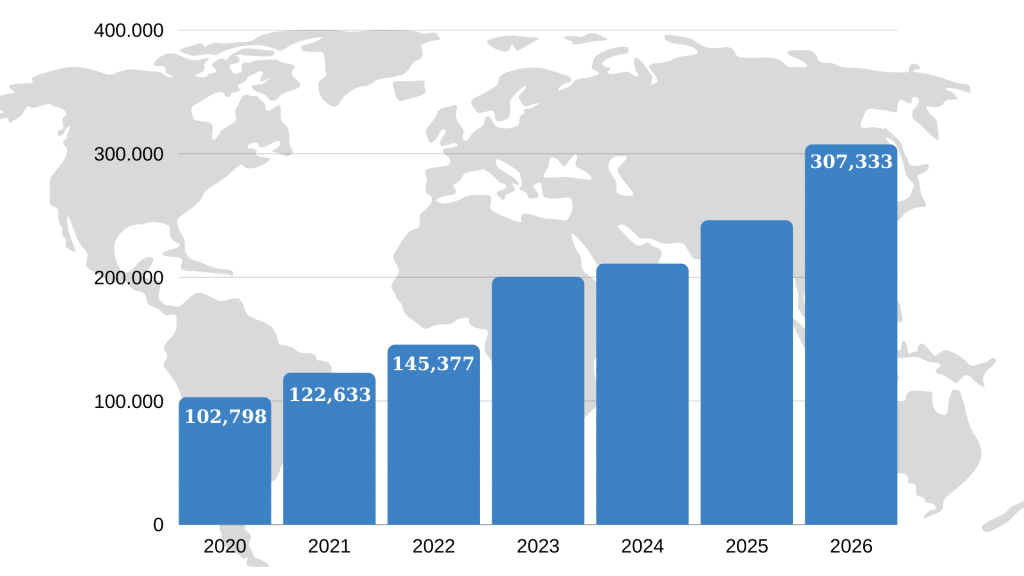
With emerging technologies such as virtualization and containerization and the 2020 pandemic, Software-as-a-Service companies have become more mainstream. Simply, these events drove a fast-growing interest in the cloud.
The global SaaS market has continued its rapid expansion, reaching over $270 billion in 2024 and projected to surpass $370 billion by 2027, according to industry analysts. SaaS companies around the world keep adopting various SaaS solutions for a variety of business needs with the help of Artificial Intelligence to solve complex business problems.
How Do B2B SaaS Sales Differ from B2C SaaS Sales?
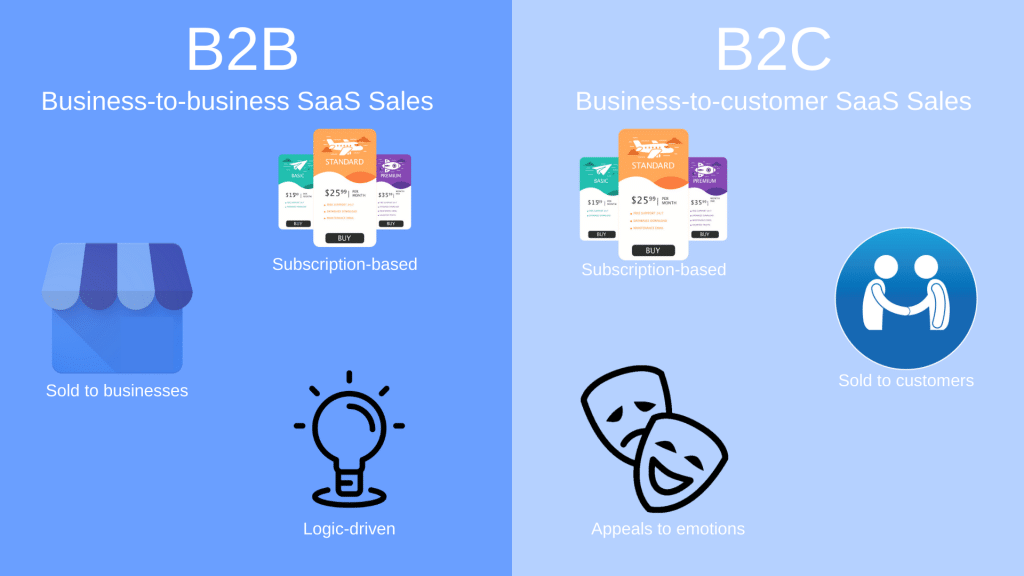
It may seem that B2C and B2B SaaS sales have many things in common. They are both based on subscriptions and deal with similar metrics like customer acquisition cost and churn rate.
But at the same time, they have different roots. B2C SaaS sales refer to any software sales process that sells directly to consumers, while B2B sales refer to the process that sells cloud-based products and services to other businesses.
With B2C sales, you are mainly dealing with a huge target market segment consisting of many individual consumers. However, with B2B sales, you usually deal with a narrow market segment with groups of professional people.
Fundamentally, one thing that differentiates B2B SaaS sales from B2C SaaS sales is that the people you are marketing to are experts. In individual consumer marketing, you hardly sell to experts.
The B2B SaaS Sales Process: Step-by-Step
Before diving into specific strategies, it helps to understand the standard stages every B2B SaaS deal moves through. While sales cycles vary in length depending on deal size and company complexity, the underlying process is consistent across most SaaS organizations.
The process typically begins with lead generation — identifying companies that fit your Ideal Customer Profile (ICP) through inbound content, outbound prospecting, referrals, or partnerships. From there, leads enter qualification, where your team determines whether the company has the budget, authority, need, and timeline to buy (BANT). Qualified leads move into discovery and demo, where you learn about their specific pain points and show how your product solves them. After the demo, deals enter evaluation and trial — especially common in product-led SaaS where free trials drive self-serve conversion. Finally, the deal reaches closing, where pricing, terms, and onboarding timelines are agreed upon.
For lower ACV deals (under $3,000/year), this cycle can complete in as little as 7-14 days through a product-led motion. For mid-market deals ($10,000-$50,000 ACV), expect a 30-90 day cycle involving multiple stakeholders. Enterprise deals over $50,000 ACV regularly require 6-12 months, multiple demos, security reviews, and legal sign-off. Understanding which motion your product requires helps you allocate sales resources correctly and set realistic pipeline expectations.
Define Your Ideal Customer Profile (ICP) and Lead Generation Strategy
One of the most common reasons B2B SaaS companies struggle with sales is they try to sell to everyone. Before building any outbound or inbound motion, you need a precisely defined Ideal Customer Profile — a description of the type of company most likely to buy, stay, and expand.
Your ICP should include firmographic attributes (company size, industry, geography, tech stack), behavioral signals (recently raised funding, hiring for a specific role, using a competitor), and outcome-based criteria (what business result does your product help them achieve?). For example, AnnounceKit’s ICP might include SaaS product teams at companies with 10-500 employees that ship frequent updates and need to keep users informed — not general businesses that never release product changes.
Once your ICP is defined, your lead generation approach becomes much more focused. Inbound leads can be attracted through SEO content, case studies, and integration marketplace listings. Outbound leads can be sourced through LinkedIn Sales Navigator, Apollo.io, or G2 buyer-intent data filtered to your ICP criteria. The goal is not volume — it is lead quality. Ten highly targeted B2B leads are worth more than 100 random signups from companies that will never convert.
How to Sell SaaS B2B: 10 Proven Strategies
In this growing B2B SaaS world, you need to stand out among the competition. You may have a great product with awesome features, but you need to know how to sell SaaS B2B to a narrow market segment with a group of professional people.
1. Curate a highly targeted digital marketplace
When people walk into a store, they love that it has an extensive product catalog, and they can find everything they are looking for. On the other hand, this equation cannot be applied to B2B SaaS buyers, and they have a completely different experience with a software product.
A significant number of features doesn’t mean a great number of customers. If you have too many features for different problems, people might get confused and overwhelmed. Most businesses need a single solution that addresses their pain point, and that’s why you need a highly targeted app marketplace for your potential customers.
At the early stages of your product development, choose three or four additional cloud services related to your core service to curate a highly targeted marketplace. By sticking to your core value, you will make it easy for everyone — both customers and stakeholders — to understand your service and value.
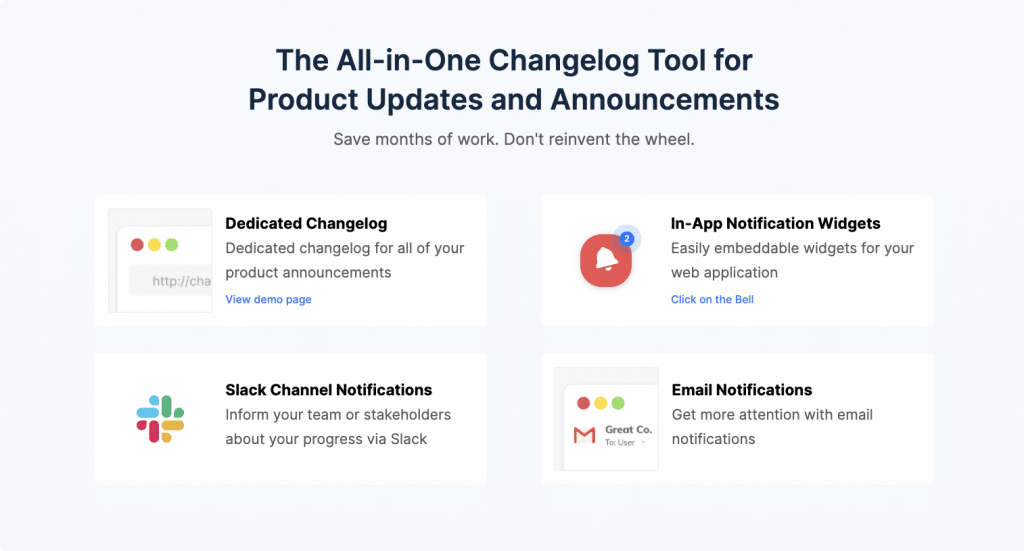
Here is an example of a highly targeted app marketplace. AnnounceKit provides a changelog service for product updates and release notes at the core of it. But it also has several other services such as widgets, notifications, and segmentation to support its core value.
2. Use pull marketing to attract your audience
There are two ways to generate leads for your product: push marketing and pull marketing. Push marketing promotes your product usually with paid advertising or promotions. Pull marketing naturally draws customer interest in your product usually with authentic and interesting content.
Push marketing is the most traditional advertising method. It is a way of saying, “I have awesome widgets at a great price” hoping that someone will make a purchase. It does not raise awareness in a superior way to move customers down to the sales funnel.
Especially in B2B SaaS sales, as you sell to experts, you need to provide valuable and authentic materials to impress them. The pull marketing method gives you the opportunity to drive customers to your web page by offering valuable content such as blog posts, social media posts, podcasts, webinars, eBooks, or white papers. Pair this with a solid set of B2B SaaS marketing strategies to create a full-funnel demand generation engine.
An example of how to sell SaaS B2B using pull marketing effectively
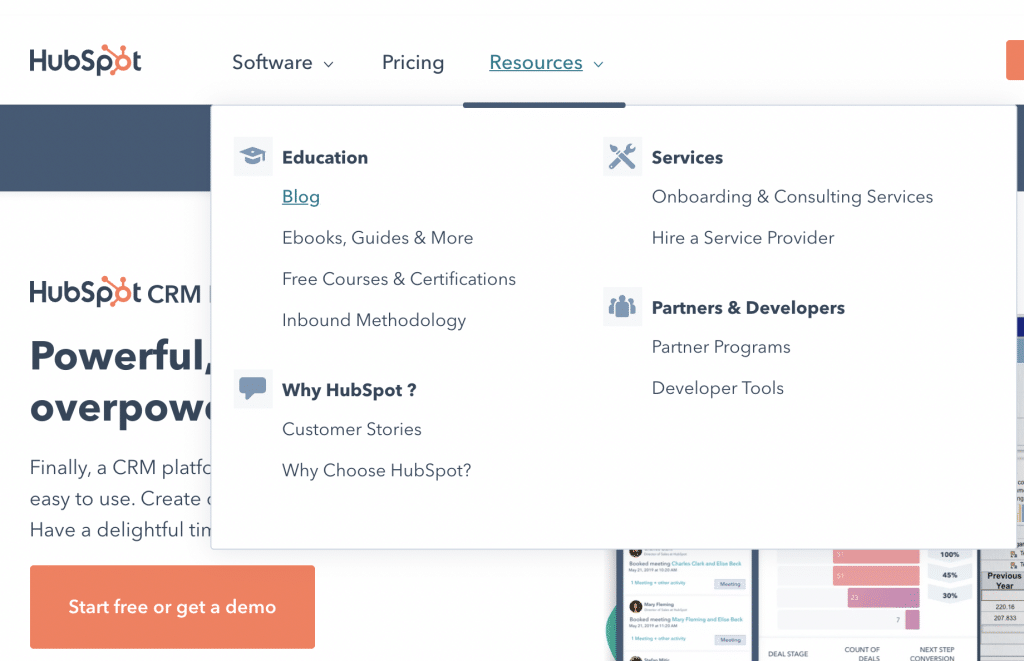
HubSpot’s marketing strategy is a great example of pull marketing. It has various content types and educational materials such as blog posts, eBooks, guides, and courses to educate its audience. They offer a significant number of business and marketing resources for free, and they organize webinars for different kinds of topics regularly to generate leads for their product.
3. Create an effective onboarding process
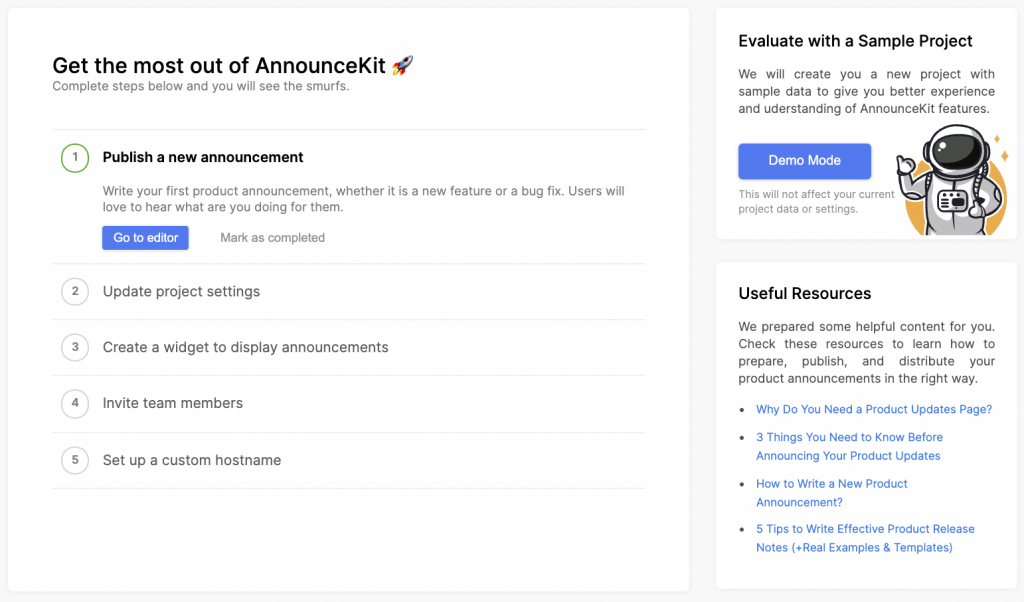
Without effective onboarding, your customers are most likely to drop using your product. Because customers generally don’t want to pay for something they cannot understand and use effectively. An ineffective onboarding process will eventually lead to a churn rate of 50 percent.
But with an effective onboarding process, you can increase your B2B SaaS sales along with establishing trust with your customers and providing opportunities for cross-selling and up-selling. AnnounceKit, for example, helps SaaS product teams keep new users informed about every new feature and improvement through in-app announcements — so that even trial users immediately see progress and value, reducing the time it takes to reach that critical “aha moment” that determines whether they convert. Learn more about user adoption strategies that complement your onboarding process.
4. Show human touch at every stage of your service
It doesn’t matter if it is B2C or B2B SaaS sales; they are all H2H (Human to Human) at the end. So, you need to show that there is a human behind the product at every stage of your service. It is not just about customer support or services; it is about the product itself.
“There is no B2B or B2C. It’s Human to Human: H2H.” — Bryan Kramer
It doesn’t matter if you are the founder, CEO, developer, copywriter, customer success manager, or any other individual responsible; each of you should be socially present — by giving an interview, attending online seminars, personally contacting customers, or using social media platforms. In B2B SaaS sales, as you are dealing with founders, CTOs, or product managers, founders and CEOs should be present and personally communicating with them.
5. Don’t sell services; sell customer-centric solutions
B2B SaaS sales are primarily about the solutions. People don’t want to know what your features are; they want to know what benefits they can obtain.
Instead of showing endless feature catalogs and promoting your product with simple phrases, sales teams need to put the pain points, solutions, and benefits first. When a customer understands the value that they are getting from your product, it is the moment that you move them down to the bottom of your B2B SaaS sales funnel. Your sales team will become trusted advisors and a critical factor in reducing customer churn. For inspiration, look at how your SaaS pricing strategy directly influences how customers perceive value from the first moment.
6. Run effective SaaS demos and optimize free trial conversion
The product demo is one of the highest-leverage moments in the B2B SaaS sales process — and one of the most commonly mishandled. A bad demo shows features. A great demo shows transformation: what the buyer’s world looks like before your product, and what it looks like after.
Before the demo, do your research. Know the company’s size, their tech stack, and the specific pain point that brought them to you. During the demo, lead with the problem they described — not a pre-built walkthrough. Show only the features that are relevant to their use case, and walk them through a realistic scenario they will recognize from their own workflow. End every demo with a clear next step: a trial, a proposal, or a follow-up meeting with additional stakeholders.
For free trials, keep the activation path short. Research from product analytics shows that users who reach their “aha moment” within the first 3 days are significantly more likely to convert to paid. Reduce time-to-value by offering a pre-configured template, a guided setup checklist, or a brief welcome call with a customer success rep. Trial users who receive proactive outreach during the trial period convert at 2-3x the rate of those who self-serve in silence.
7. Handle objections before they become blockers
Every B2B SaaS deal encounters objections. The most common ones are price, implementation complexity, security concerns, and the classic “we’re happy with our current solution.” The best sales teams don’t wait for objections to surface — they anticipate them and address them proactively throughout the sales cycle.
When the objection is price, reframe the conversation around ROI. Calculate the cost of the problem your product solves — whether it’s engineer hours wasted, churn caused by poor communication, or revenue lost to slow feature adoption — and show how your pricing compares to that cost. When the objection is security or compliance, have your SOC 2 report, GDPR documentation, or security FAQ ready to send before the question is even asked.
For the “we’re happy with what we have” objection, ask discovery questions that reveal the hidden cost of the status quo. Most companies are not actually satisfied with their current tools — they have just never calculated how much the friction costs them. Helping a buyer see that cost is often the turning point that moves a deal from stuck to closed.
8. Use a CRM and the right sales tools
Effective B2B SaaS sales requires systematic tracking of every lead, conversation, and deal stage. A CRM is not optional — it is the foundation that enables your team to follow up consistently, identify pipeline risks, and forecast revenue accurately.
For early-stage SaaS teams, HubSpot CRM (free tier) or Pipedrive are common starting points. As you scale, Salesforce or Attio offer more sophisticated pipeline management. Layer on top: a sales engagement platform like Apollo.io or Outreach for sequences, a call recording tool like Gong or Chorus for coaching, and LinkedIn Sales Navigator for account research. The goal is not to have the most tools — it is to have the right ones for your sales motion, used consistently by your entire team.
9. Treat churn reduction as part of your sales strategy
Many SaaS teams make the mistake of treating sales and retention as separate functions. In reality, churn is a sales problem. Every customer who churns is a deal you have to re-win, and high churn rates actively suppress growth because revenue leaks out of the bottom of the funnel faster than it can be poured in the top.
The sales team plays a direct role in churn prevention by setting accurate expectations during the sales process. Overselling features that aren’t ready, misrepresenting implementation complexity, or closing customers who aren’t a strong ICP fit are all sales decisions that create churn problems 90 days later. Train your reps to qualify out poor-fit prospects rather than hitting quota with customers who will be gone in three months.
Post-sale, the customer success team takes ownership — but the handoff quality matters enormously. A structured onboarding handoff with clear documentation of what the customer bought, what they were promised, and what success looks like for them is the single most impactful way to reduce early-stage churn.
10. Measure what matters: B2B SaaS sales metrics
You cannot improve what you do not measure. Every B2B SaaS sales team should have a shared set of core KPIs that are reviewed weekly and used to diagnose pipeline health.
The most important metrics to track are: Monthly Recurring Revenue (MRR) — your normalized monthly subscription revenue, the primary growth indicator; Customer Acquisition Cost (CAC) — total sales and marketing spend divided by new customers acquired; Customer Lifetime Value (LTV) — average contract value multiplied by average customer lifespan; LTV:CAC ratio — should be at least 3:1 for a healthy SaaS business; Churn rate — the percentage of customers or revenue lost in a given period; Win rate — percentage of qualified opportunities that close; and Average Sales Cycle Length — the median number of days from first touch to closed-won. For B2B SaaS with ACV under $5K, a sales cycle of 14-30 days is typical; ACV $10K-$50K typically runs 60-90 days.
Tracking these metrics consistently allows you to identify bottlenecks — whether deals are stalling at demo stage, whether CAC is rising faster than LTV, or whether a specific industry vertical churns at a higher rate than others. Data-driven sales teams consistently outperform intuition-driven ones.
Frequently Asked Questions About How to Sell SaaS B2B
What is the typical B2B SaaS sales cycle length?
The length of a B2B SaaS sales cycle depends primarily on the annual contract value (ACV) and the number of stakeholders involved. For self-serve products with ACV under $3,000, the cycle can be as short as 7-14 days. For mid-market deals in the $10,000-$50,000 ACV range, expect 30-90 days. Enterprise deals above $50,000 ACV often take 6-12 months, involving legal review, security assessments, and executive sign-off. The best way to shorten your cycle is to qualify leads more precisely upfront and reduce friction in the trial and demo stages.
How do you qualify B2B SaaS leads effectively?
The most widely used B2B SaaS qualification framework is BANT: Budget (does the prospect have financial resources allocated for this type of solution?), Authority (are you speaking with the person who can approve the purchase?), Need (do they have a genuine, urgent problem your product solves?), and Timeline (are they actively looking to make a decision now?). More modern frameworks like MEDDIC or SPICED add additional dimensions like economic impact and decision criteria, which are especially useful for enterprise deals. The goal of qualification is not to filter aggressively — it is to ensure your team invests time in opportunities that can realistically close.
What metrics matter most in B2B SaaS sales?
The core metrics every B2B SaaS sales team should track are MRR (monthly recurring revenue), CAC (customer acquisition cost), LTV (customer lifetime value), the LTV:CAC ratio (healthy benchmark is 3:1 or higher), churn rate, win rate, and average sales cycle length. At the pipeline level, tracking stage-by-stage conversion rates helps identify where deals stall. For product-led growth companies, activation rate and trial-to-paid conversion rate are equally important leading indicators of revenue health.
What makes B2B SaaS sales different from selling to consumers?
B2B SaaS sales involves longer decision cycles, multiple stakeholders, and significantly higher average contract values than consumer sales. B2B buyers are professionals evaluating how your software will integrate with their existing workflows, scale with their team, and deliver a measurable return on investment. They require proof — case studies, ROI calculators, security documentation, and references — before they commit. Consumer sales are often driven by emotion and immediate need; B2B sales require building organizational consensus and demonstrating business value across different departments.
How do you reduce churn in B2B SaaS?
Reducing churn starts at the sales stage by qualifying out poor-fit customers and setting accurate expectations during the sales process. After closing, a structured onboarding process that helps customers reach their first meaningful outcome quickly is the most impactful churn reduction lever. Companies that use in-app changelog tools like AnnounceKit to keep users informed of new features and improvements consistently see higher activation and retention rates because users understand the product’s ongoing value.
How do you run a successful B2B SaaS demo?
A successful B2B SaaS demo starts with research and a discovery call before the demo itself. You should know the prospect’s company size, their current solution, their specific pain point, and their decision timeline before you start presenting. During the demo, lead with the problem — not the product — and show only features relevant to their use case. End with a clear next step: a trial invitation, a proposal, or a follow-up with additional stakeholders. After the demo, send a brief recap email within 24 hours covering what was discussed and what happens next.
Conclusion
B2B SaaS sales requires a coordinated set of approaches to consistently sell software to businesses and retain them. Whether you’re focusing on defining your ICP, optimizing your demo process, or tracking the right metrics, the foundation is the same: understand your buyer deeply, remove friction at every stage of the journey, and deliver genuine value before and after the sale.
With a well-developed lead generation strategy, pull marketing approach, effective onboarding process, proactive objection handling, and data-driven metrics tracking, you can build a sustainable B2B SaaS sales engine that compounds over time.