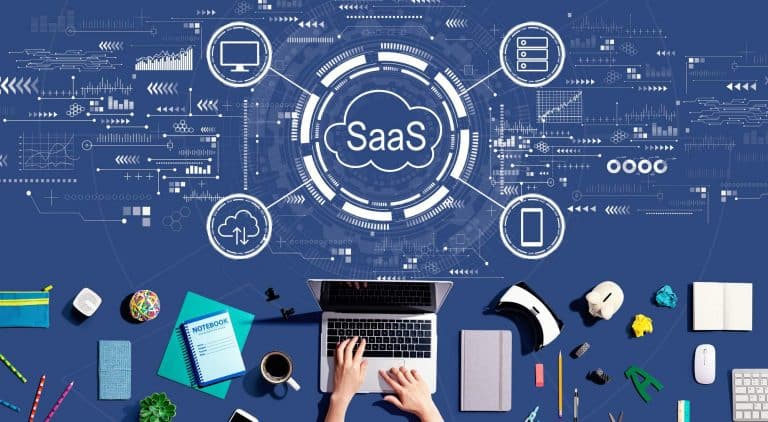
AI in SaaS refers to the integration of artificial intelligence technologies — such as machine learning, natural language processing, and predictive analytics — directly into software-as-a-service products to automate workflows, personalize experiences, and unlock insights from data. In 2026, AI is no longer a differentiator for SaaS companies: it is a baseline expectation. Companies that embed AI into their products see engagement lifts of 40–60%, while those that ignore it risk losing customers to competitors that save users measurable time every day.
So what does AI actually look like inside a SaaS product, and why should your company be adopting it right now? This guide covers the definitions, core technologies, real-world use cases, challenges, and future trends — everything you need to make an informed decision.
What Is AI in SaaS?
AI in SaaS is the practice of embedding machine intelligence into cloud-delivered software so the product learns, adapts, and improves over time without constant human reprogramming. Unlike traditional software, which follows fixed rules, an AI-powered SaaS product observes patterns in user behavior, product data, and external signals — then uses those patterns to make decisions, surface recommendations, or automate repetitive tasks automatically.
A simple example: a project management SaaS tool that uses AI will notice that a particular team member consistently finishes tasks two days late and proactively flag that risk to the project manager before a deadline is missed. A traditional tool would only show the missed deadline after it happened. This is the fundamental difference AI brings — it moves SaaS products from reactive to proactive.
The term “AI in SaaS” covers a wide spectrum. At one end you have simple rule-based chatbots that answer FAQs. At the other end are fully autonomous agents that can plan projects, write code, and execute multi-step workflows with minimal human input. In 2026, most competitive SaaS products sit somewhere in the middle: using machine learning models trained on their own data to deliver personalized, intelligent experiences at scale.
Core AI Technologies Used in SaaS
Understanding which AI technologies power modern SaaS products helps you evaluate what to build or buy. The four most important are machine learning, natural language processing, predictive analytics, and intelligent automation — and most leading SaaS products combine all four.
Machine Learning (ML) is the foundation. ML models find patterns in large datasets and use those patterns to make predictions or decisions without being explicitly programmed for each scenario. In SaaS, ML powers everything from spam filters and fraud detection to churn prediction and dynamic pricing. The model trains on your historical data, improves as more data flows in, and produces outputs that get more accurate over time.
Natural Language Processing (NLP) enables software to understand, interpret, and generate human language. Every AI chatbot, voice assistant, sentiment analysis tool, and AI writing assistant in the SaaS ecosystem relies on NLP. With the arrival of large language models (LLMs) like GPT-4 and Claude, NLP capabilities that used to require a dedicated research team can now be accessed via an API call — making it practical for SaaS companies of any size to add conversational AI to their products.
Predictive Analytics uses historical data, statistical algorithms, and ML techniques to forecast future outcomes. In SaaS, this translates to predicting which trial users will convert, which paying customers are at risk of churning, which features will drive the most engagement, and what revenue will look like next quarter. Predictive analytics turns your product’s data into a competitive intelligence engine.
Intelligent Automation combines AI with workflow automation to execute multi-step business processes without human intervention. Unlike simple rule-based automation (if X then Y), intelligent automation can handle exceptions, learn from edge cases, and adapt to changing conditions. In SaaS products, this appears as AI-generated reports, auto-scheduled communications, smart routing of support tickets, and autonomous data enrichment.
Providing Better Customer Support Experiences
One of the most important advantages of artificial intelligence for SaaS companies is that it contributes to the improvement of customer satisfaction and loyalty rates. ⭐
You have probably used the chat support option on any e-commerce site or banking transactions. So what were we doing when there was no chat support? Let me tell you: we were waiting on the phone for minutes and we were wasting time!
Currently, thanks to artificial intelligence-supported chat support, we can find solutions to our problems or get answers to our questions within seconds. Of course, this might be possible on a well-running system. 💪🏻
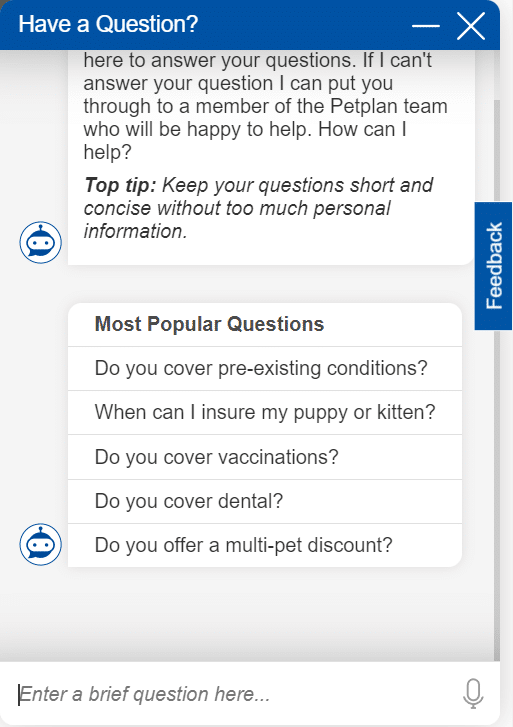
Another advantage of this technology is that it collects every reply message as feedback. At the end of the day, you can focus on the issues your customers are having the most trouble with by looking at the statistics.
In addition, thanks to chat support with artificial intelligence, you can only convey the necessary issues to your real customer support employee. Your artificial intelligence-assisted assistant transmits the necessary information to the customer support team and offers a definitive solution based on the information they have.
Customers are happy, your employees are happy, and you are happy. I really love technology! 🎃
Ability to Analyze Data and Collect Insights
Artificial intelligence technology brings with it powerful analysis capabilities. Thanks to AI, you begin to read data correctly and use this data to your advantage.
Artificial intelligence can meticulously track user behavior and infer meanings based on historical data. For example, it can draw behavior graphs of users who unsubscribe. Users who perform similar actions with these users are perhaps considering terminating their subscriptions.
Thanks to artificial intelligence, you can predict these users using historical data and contact them before unsubscribing. SaaS companies that detect user problems also have a chance to reduce cancellation rates. 📉
Let’s take a look from another perspective. There are things you don’t like about the product you are using; some features do not work as you want, or you frequently encounter errors. They anticipate your concerns and contact you, and your problems begin to disappear one by one.
This example demonstrates the power of data and artificial intelligence! 💪🏻
Ensuring Better Security Solutions Against Threats
When good and effective technology is used, groups that want to use this technology for bad purposes also emerge quickly. Yes, you guessed it, right. Hackers.
They take action to empty bank accounts, collect user information and sell it to different people, or simply show that they can do it. Hackers are a huge threat to SaaS companies, and the company’s reputation suffers when a successful cyberattack becomes public.
So what is the solution SaaS companies need? They have moved from a computer-centric system to a cloud-based one, but this was not an adequate solution. Considering that thousands of users have access to SaaS tools, the risk increases proportionally.
So many SaaS companies have recently added machine learning and AI to protect their cloud security services. With these technologies’ power, they can automatically identify unusual behaviors, by this way conduct suitable incident response or remediation to address the issue. More SaaS companies are turning to AI as this technology is proved to be the new powerful cybercriminal repellent. 💻
Saving More Time for Customers
Time is a really valuable concept for humans. No matter how much money we have, we cannot buy time. One of the features that we will highlight when defining artificial intelligence is that it does a lot of work for us. Let’s think about all the projects and jobs artificial intelligence works for us: e-commerce, health services, software technology, marketing, and so on.
This is the key point for people when they need to choose a SaaS product for themselves or their business. Ask yourself: Does my tool have AI features? Does it help people by saving time? Does it make people’s work easier? If your answers are yes, people will choose your product with confidence. If not, you’d better add AI-powered features before your competitors do — because modern buyers expect it.
Thanks to artificial intelligence, users become loyal advocates of your product. When they experience a tool that learns their preferences, anticipates their needs, and reduces their workload, they don’t just stick around — they recommend it to others. That compounding effect on retention and word-of-mouth is one of the most powerful growth levers AI unlocks for SaaS companies. 🤖
Real-World Use Cases of AI in SaaS
AI in SaaS is not theoretical — it is already deployed across virtually every category of software. Here are the use cases that are delivering measurable ROI for SaaS companies in 2026:
Marketing Automation: AI-powered SaaS tools segment audiences in real time, personalize email subject lines and content at the individual level, optimize send times, and predict which leads are most likely to convert. Platforms like HubSpot and Marketo use ML models trained on billions of interactions to surface the next best action for each contact — something that would take a human team weeks to replicate manually.
Customer Relationship Management (CRM): AI in CRM tools like Salesforce Einstein analyzes every customer interaction — emails, calls, support tickets, product usage — and synthesizes it into a health score. Sales reps see which accounts need attention, which deals are at risk of slipping, and which customers are ready to expand. This transforms CRM from a record-keeping system into a revenue intelligence platform.
Product Analytics and Personalization: SaaS analytics tools use AI to identify which features drive retention, which user segments are most valuable, and which onboarding paths lead to activation. AnnounceKit, for example, uses AI to help product teams craft targeted in-app notifications that reach the right users at the right moment — improving feature adoption without adding developer workload.
Financial Forecasting: AI-powered financial SaaS tools ingest revenue data, payment patterns, and market signals to produce rolling forecasts that update automatically. Instead of an analyst spending two days building a spreadsheet model, the AI generates a probabilistic forecast with confidence intervals in minutes — freeing finance teams to focus on interpretation and strategy rather than data wrangling.
Customer Support Automation: Beyond basic chatbots, AI in modern support SaaS can classify tickets, route them to the right team, suggest replies to agents, and fully resolve a growing percentage of issues without human involvement. This dramatically reduces cost-per-ticket and mean time to resolution, while keeping customer satisfaction high.
Who Else Is Using AI in Their SaaS Product?
AnnounceKit has many customers from different countries around the world. So what kind of service does AnnounceKit provide to its users?
AnnounceKit is an AI SaaS product that helps companies announce product updates and news to their customers. (If you have questions about making effective announcements, this article is for you.) Companies raise their customer satisfaction rates and reduce churn rates because of the services AnnounceKit gives them.
Since all these companies are from different sectors, they have different needs. Then, AnnounceKit has developed a new feature powered by artificial intelligence technology!
You may need to make dozens of announcements during the day. You have thousands of customers and you need to write announcement texts for different segments. Because the announcement you make may not be of interest to everyone. Now you can announce product updates in seconds without worrying about writing or formatting them yourself. Just give some keywords, and the AI-powered assistant takes care of the rest!
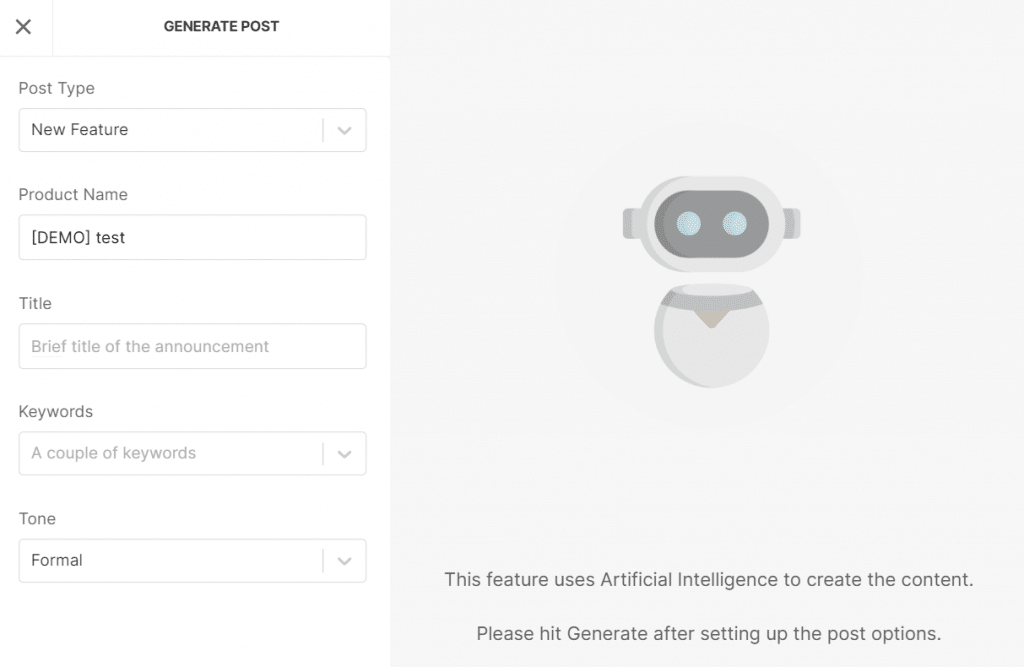
AnnounceKit also announces its own product developments through the application. Why not have the AI Writing Assistant write the announcement itself? The team did exactly that — a perfect example of eating your own dog food with AI. For SaaS companies thinking about B2B SaaS marketing strategies, using AI to personalize and automate product communications is one of the highest-leverage tactics available today.
Challenges of Implementing AI in SaaS
AI adoption in SaaS is not without friction. Understanding the real challenges helps you plan for them rather than be surprised by them — and separates companies that successfully deploy AI from those that announce initiatives that never ship.
Data Privacy and Security Concerns: AI models are only as good as the data they train on, and that data often contains sensitive customer information. GDPR, CCPA, and emerging AI-specific regulations require SaaS companies to be explicit about what data is used for training, how it is stored, and how customers can opt out. Companies that don’t address these concerns upfront face regulatory risk and loss of customer trust — both of which are expensive to recover from.
High Implementation Costs: Building AI capabilities from scratch is expensive in both engineering time and cloud compute costs. Training and serving ML models at scale requires specialized infrastructure and talent. For most SaaS companies, the build-vs-buy question is increasingly answered by buying: using AI APIs and third-party ML platforms to access capabilities without building the underlying infrastructure. This reduces time-to-market from months to weeks but requires careful vendor evaluation.
Bias in AI Algorithms: AI models can inherit and amplify biases present in their training data. In SaaS contexts, this can manifest as an AI churn model that systematically underscores certain customer segments, or a recommendation engine that favors features used by large enterprise customers over SMBs. Regular model auditing and diverse training datasets are essential safeguards — not optional extras.
Integration With Existing Systems: Most SaaS companies operate with a stack of existing tools, databases, and APIs. Integrating AI capabilities into this stack — so that models have access to the right data and their outputs flow into the right workflows — is often more complex than building the model itself. A clear data architecture strategy is a prerequisite for successful AI implementation, not an afterthought.
The Future of AI in SaaS
The AI capabilities that feel advanced today will be table stakes in 24 months. Here are the trends reshaping what AI in SaaS will look like through 2026 and beyond:
Agentic AI: The next major shift in AI for SaaS is from assistants to agents — AI systems that don’t just answer questions but autonomously plan and execute multi-step tasks. Instead of asking an AI to “draft a follow-up email,” an AI agent in a CRM will detect a deal going cold, draft the email, choose the optimal send time, monitor the response, and update the pipeline status — all without a human initiating each step. 82% of enterprise companies are actively piloting AI agents in 2026, according to industry research.
Embedded AI Becoming the Default: The era of AI as a premium add-on is ending. By 2027, AI capabilities will be embedded so deeply into SaaS products that users will not think of them as “AI features” at all — just as we don’t think of spell-check as AI despite it being exactly that. SaaS companies that have not integrated AI into their core product workflow by then will face significant pricing pressure and positioning challenges.
Usage-Based AI Pricing: As AI features become central to product value delivery, SaaS companies are shifting from seat-based pricing to usage-based models that charge based on AI outputs — documents generated, predictions made, workflows automated. This aligns pricing with the value customers receive and creates more sustainable unit economics as compute costs continue to fall.
Generative AI for Product Communication: Generative AI is transforming how SaaS companies communicate product changes to their users. Teams can now auto-generate product management in SaaS-aligned release notes, personalized update summaries, and in-app announcements tailored to each user segment — at a fraction of the time previously required. This makes it possible for even small product teams to maintain high-quality, consistent product communications at scale.
Conclusion
For some, artificial intelligence will remain a myth that will bring about the end of humanity. While people continue to argue about it, many companies will continue to develop new AI-powered features and make people’s lives easier.
SaaS companies that act according to the needs of the age can sustain growth rates. However, companies advancing with a traditional vision face an increasingly difficult competitive environment as AI-native competitors enter every category.
Catching success is in your hands. If the above reasons make sense to you, start working right away and benefit from the power of artificial intelligence. The companies winning in SaaS today are not just using AI — they are building products where AI makes every user interaction faster, smarter, and more valuable.
Frequently Asked Questions About AI in SaaS
What is AI in SaaS?
AI in SaaS refers to the integration of artificial intelligence technologies — including machine learning, natural language processing, and predictive analytics — into cloud-delivered software products. These AI capabilities enable SaaS products to learn from user data, automate repetitive tasks, personalize experiences at scale, and make predictions that help users and businesses make better decisions. Unlike traditional software that follows fixed rules, AI-powered SaaS products improve automatically as they process more data over time.
How do SaaS companies use AI?
SaaS companies use AI in multiple ways across their products and operations. Common applications include AI-powered chatbots and support automation that resolve customer issues without human agents, machine learning models that predict churn and identify upsell opportunities, natural language processing for sentiment analysis and AI writing assistants, predictive analytics for revenue forecasting and product roadmap prioritization, and intelligent automation that handles repetitive workflows like data enrichment, report generation, and personalized communications.
What are the key benefits of AI for SaaS companies?
The primary benefits of AI for SaaS companies include significantly improved customer retention through proactive churn detection and personalized engagement, reduced operational costs through automation of support, marketing, and data analysis workflows, faster product development cycles as AI surfaces user behavior insights that inform roadmap decisions, stronger security through AI-powered threat detection and anomaly monitoring, and a meaningful competitive advantage as AI-native products increasingly outperform traditional software on user experience metrics.
What are the main challenges of implementing AI in SaaS?
The main challenges of implementing AI in SaaS are data privacy and regulatory compliance (especially under GDPR and CCPA), the high upfront cost of building ML infrastructure and acquiring AI talent, the risk of algorithmic bias if training data is not representative and regularly audited, and the complexity of integrating AI capabilities with existing product architecture and third-party systems. Most SaaS companies address these by using pre-built AI APIs and cloud ML platforms rather than building from scratch, which reduces cost and time-to-market significantly.
Which SaaS companies are using AI successfully?
Many leading SaaS companies have made AI central to their product value proposition. Salesforce uses AI (Einstein) for sales forecasting, lead scoring, and customer health monitoring. HubSpot uses AI for content creation, SEO optimization, and predictive lead scoring. Slack uses AI for channel summarization and smart search. Notion uses AI for document drafting and information retrieval. AnnounceKit uses AI to help product teams write and personalize product announcements, release notes, and in-app notifications — reducing the time to communicate a product update from hours to minutes.
How can I add AI features to my SaaS product?
The most practical path for most SaaS companies is to start with AI APIs rather than building models from scratch. OpenAI, Anthropic, Google, and AWS all offer powerful AI capabilities accessible via API that can be integrated into your product in days rather than months. Start by identifying the highest-value use case — typically customer support automation, personalization, or predictive analytics — and build a focused proof of concept. Measure the impact on your key metrics before scaling. Once you have validated the business case, you can evaluate whether to deepen your use of third-party AI services or invest in building proprietary models on your own data.
Is AI in SaaS the same as automation?
AI and automation are related but distinct. Traditional automation executes predefined rules — if X happens, do Y. AI-powered automation goes further: it can handle exceptions, learn from edge cases, adapt to new patterns, and make probabilistic decisions rather than binary ones. In a SaaS context, a simple automation might send a welcome email when a user signs up. An AI-powered system would analyze that user’s role, company size, and signup behavior to send a personalized onboarding sequence most likely to lead to activation — a decision no fixed rule set could make reliably at scale.
What is the future of AI in SaaS?
The future of AI in SaaS is agentic, embedded, and usage-priced. Agentic AI — systems that autonomously plan and execute multi-step workflows without constant human direction — is moving from research labs to production deployments in 2025–2026. Embedded AI will become so standard in SaaS products that it will no longer be marketed as a distinct feature, just as cloud hosting is not a selling point today. And usage-based pricing tied to AI outputs will reshape SaaS business models, aligning revenue more directly with the value delivered. SaaS companies that treat AI as a core architectural decision rather than a feature addition will be best positioned for this shift.

Quick Setup, Easy To Use, and Many Integrations
Manage your product announcements from a single place and easily distribute them
across multiple channels